 Lake Havasu Golf Cart Repair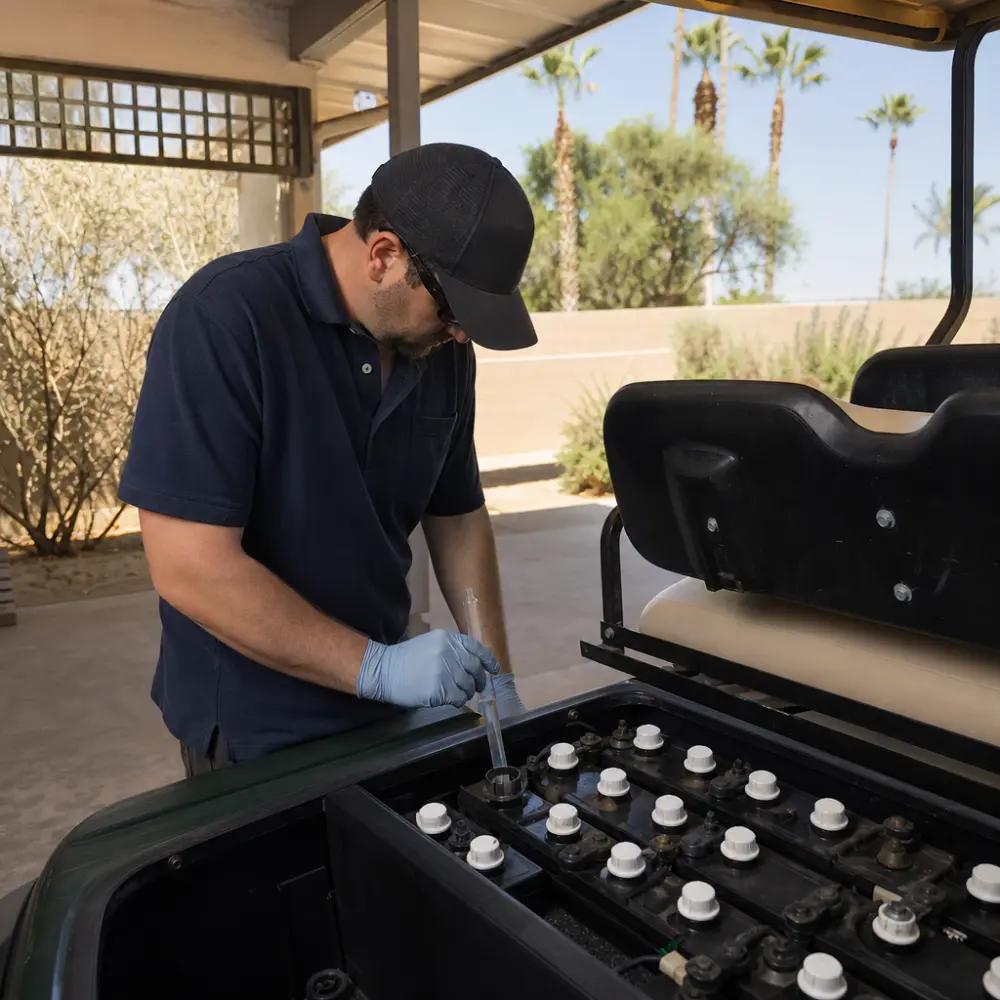
Lake Havasu Golf Cart Repair sends a technician to your driveway, garage, or dock anywhere in Lake Havasu City and the surrounding river corridor and fixes your cart on-site: batteries, brakes, tires, chargers, solenoids, motors, controllers, and lights. A full lead-acid battery pack runs $1,200 to $1,800 installed, brake work $75 to $400, tires $75 to $150 each, and the $50 to $100 service call is applied toward your repair. Describe the symptom by form and we usually arrive with the likely parts already on the truck.
Lake Havasu City is a lake town before it is a retirement town, though it is plenty of both. The city was laid out by developer Robert P. McCulloch starting in 1963 and incorporated in 1978; the 2020 Census counted 57,144 residents with a median age of 56.1. Every winter that population grows again as retirees from colder states and Canada move in for the season, and every carts-per-household story in this town traces back to the same fact: the lake is the point, and a golf cart is how most people move gear, groceries, and grandkids between the driveway and the dock.
What we fix, at your home or dock
- Mobile golf cart repair: the core service. On-site diagnosis and repair of whatever is wrong: will not move, will not charge, weak on the way back from the marina, clicking, cutting out. All major brands, electric and gas.
- Battery replacement: new lead-acid packs installed with haul-away of the old cores, plus honest lead-acid versus lithium math for a cart that runs hard in a Havasu summer.
- Brakes and tires: adjustments, shoes, drums, and new tires installed in your driveway. The grade between the lake and the rest of town wears brakes faster than owners expect.
- Motor and controller repair: solenoids, speed controllers, and drive motors diagnosed with meters before anything gets replaced.
- Charger repair: carts that “will not take a charge” are often a charger, charge port, or corroded connection, not a battery problem. We test before we sell you anything.
- Tune-up service: the desert-summer annual: battery water and load test, terminal cleaning, brakes, tires, lights, and a corrosion check built around a climate that is genuinely one of the hottest in the country.
- Lights and street-legal equipment: headlights, brake lights, signals, mirrors, and reflectors installed to what Arizona’s neighborhood electric vehicle statute actually requires.
Full ranges for everything are published on the pricing page. Competitors make you call for a number. We would rather you see it first.
Why Havasu carts break the way they do
Heat is the battery killer, and this is a genuinely extreme case of it. The National Weather Service’s climate normals for Lake Havasu City put the June mean daily high at 105.1°F and July at 109.3°F, and the hottest temperature ever recorded anywhere in Arizona, 128°F, was measured right here on June 29, 1994. Inside a flooded lead-acid battery, heat like that evaporates water out of the electrolyte fast, and once the level drops below the top of the plates, the exposed lead sulfates and permanently loses capacity. A closed cart garage or dock box runs hotter still than the air outside. A pack rated for five or six years of duty in a milder climate often taps out at two or three here. Watering on a tight schedule from April through October is the single cheapest thing you can do for a $1,200 pack.
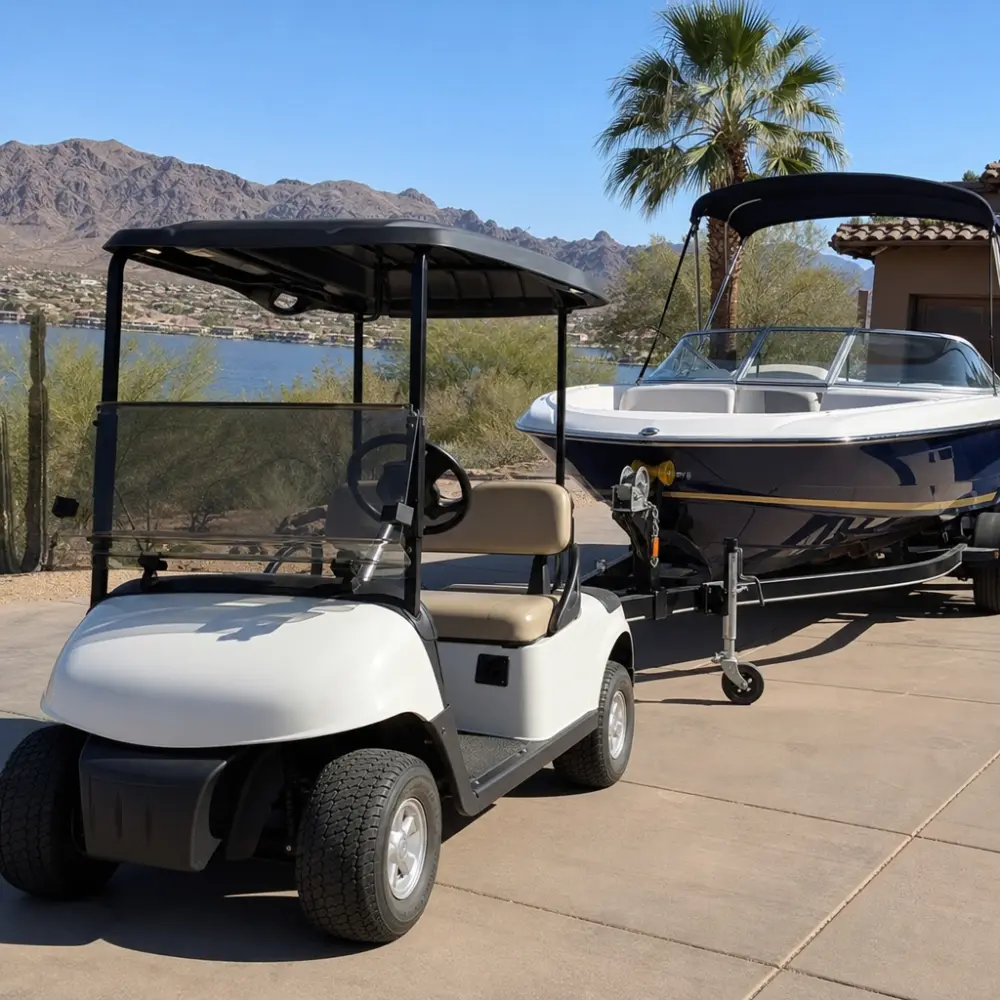
The lake cuts the other way. Annual rainfall here averages just 4.16 inches, one of the driest readings in the state, so corrosion from humidity is not the story it is in a coastal market. What does corrode terminals and connectors is splash and spray: carts that live at a dock or get loaded with wet gear off a boat see far more moisture at the battery bay than a driveway cart ever does. We check for that specifically on Island and Parker Strip calls.
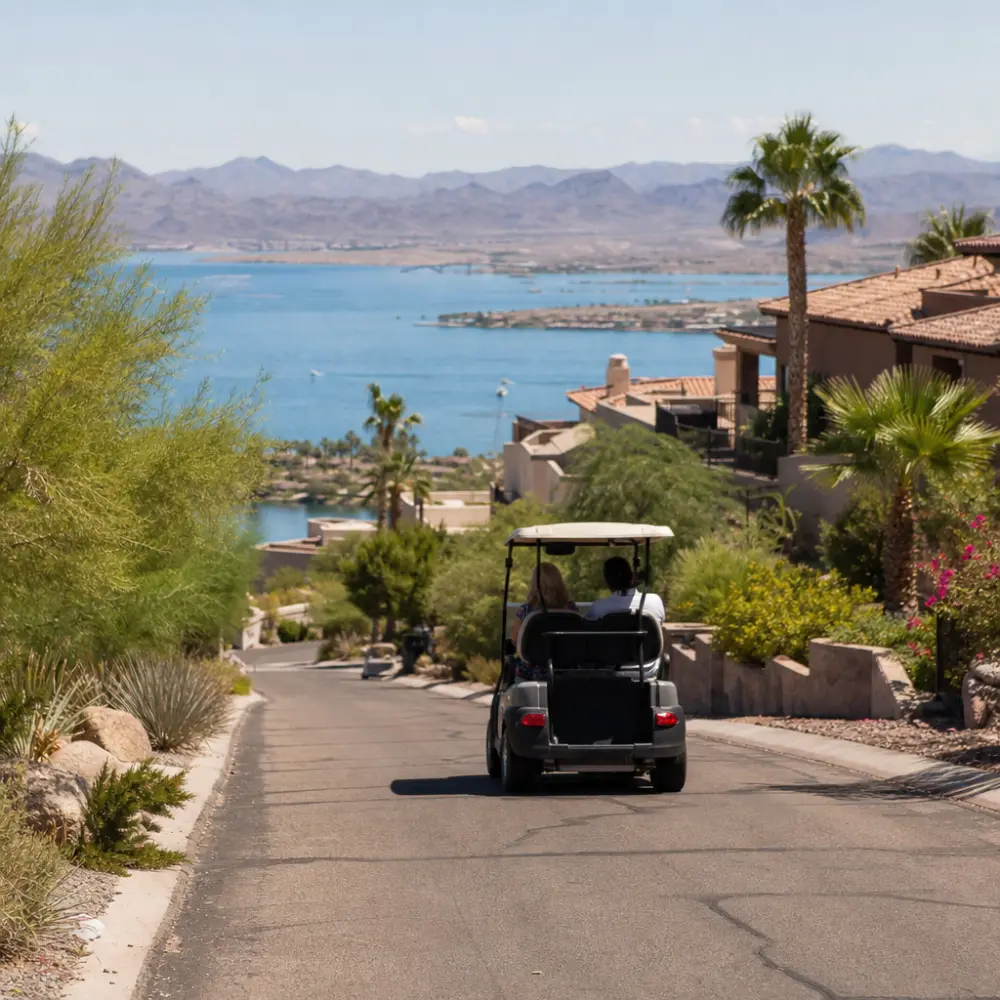
The town has real hills. The lake sits at roughly 452 feet of elevation where London Bridge crosses the Bridgewater Channel, and Lake Havasu City’s own airport, six miles north of downtown, sits at 783 feet. That is more than 300 feet of climb inside city limits, and carts working that grade daily, especially loaded ones headed up from the water, work brakes and controllers harder than a flat retirement-community grid ever would.
Snowbird carts sit through the worst months. A lot of houses here empty out for the summer the way houses in colder climates empty out for the winter, and a cart left on a partial charge through June, July, and August in a closed Havasu garage is a near-guaranteed dead pack by October. If that is your cart, read sat all summer, will not start before buying anything.
Golf cart or NEV: the category that actually decides your street rights
Arizona does not use a simple speed line the way some states do. A.R.S. 28-101(38) defines a golf cart as a vehicle with at least three wheels, unladen weight under 1,800 pounds, designed for no more than 25 mph, carrying no more than four people. A.R.S. 28-101(56) defines a neighborhood electric vehicle separately: emission-free, at least four wheels, and built to the full federal low-speed vehicle equipment standard, meaning lights, signals, mirrors, a windshield, seat belts, and a VIN from the factory. A stock golf cart does not become an NEV just because it is fast enough or has a light bar bolted on.
Only a genuine NEV has a general right to use Arizona streets posted 35 mph or less, under A.R.S. 28-966. There is a narrower state allowance, A.R.S. 28-721(C), that lets a plain golf cart onto a road shoulder, but only in an age-restricted community in the unincorporated part of a county over 3 million people. Mohave County’s 2020 Census population was 213,267, nowhere close, so that allowance does not reach Lake Havasu City, Desert Hills, or anywhere else here. We looked for a city ordinance that fills the gap and did not find one. The full breakdown, with every statute section, is on our street-legal rules page.
Where the carts live
The Island is the center of gravity for anyone whose cart lives near the water: the peninsula McCulloch turned into an island when the Bridgewater Channel was dredged under London Bridge in 1971, now hotels, restaurants, and homes on both the channel and the open lake. Desert Hills sits just a couple of miles from the city, an older, quieter retirement-heavy pocket. South along the river, Parker Strip and the town of Parker itself, the La Paz County seat, are their own cart market built around vacation homes on the water. North of town, Topock and Golden Shores sit where I-40 crosses the Colorado River.
How a mobile visit works
- Tell us the symptom. Will not move, clicks but no go, will not charge, sags coming back from the marina, squeals when braking. Most problems narrow down fast from a good description, so the tech arrives with the likely parts.
- We come to you. Driveway, garage, or dock, at a scheduled window. The $50 to $100 trip fee includes the diagnostic and gets applied to the repair.
- We diagnose before we recommend. Load test on each battery, voltage checks across the pack, charger output test, voltage drop along the main cables, solenoid and controller checks. We isolate the actual fault instead of selling the most expensive maybe.
- Flat quote on the spot, fix on the spot. Battery sets, solenoids, brake shoes, and tires are usually on the truck. Approve the number and most jobs are done in that same visit.
- Finish clean. Lead-acid packs get watered and terminals cleaned and coated, everything gets a torque check and a test drive, and old batteries leave with us for recycling.
Straight answers, published prices
Two things we will not do. We will not pretend to be something we are not: we are an independent service, not an authorized dealer or warranty center for Club Car, E-Z-GO, Yamaha, ICON, or Evolution. If your cart is under factory warranty, your selling dealer should handle warranty work. And we will not sell parts you do not need. A cart that will not charge gets a charger and charge-port test before anyone talks about a battery pack, and a weak cart gets a per-battery load test before we condemn six batteries when one is the problem. If a repair does not make sense against the value of an old cart, we will say that too.
The work is done by experienced, insured local golf cart technicians. More on how we operate is on the about page, and the FAQ answers the questions we hear most.
Get a fast quote
A lot of owners land here after typing “golf cart repair near me” with a cart that will not leave the garage in the middle of an Arizona summer. That is exactly the call this service was built for. Tell us the brand, model year if you know it, whether it is a 36V or 48V electric or a gas cart, and what it is doing. A photo of the battery compartment or dash helps. We will come back fast with a flat number and a scheduling window, and in most cases we can reach you same-day or next-day anywhere from the Island to Desert Hills to the Parker Strip.