 Lake Havasu Golf Cart Repair
 Mobile Golf Cart Repair in Lake Havasu City
Mobile golf cart repair means the technician comes to you, wherever the cart actually sits: driveway, garage, dock, or boat barn, anywhere from Lake Havasu City through Desert Hills, the Island, Parker Strip, and up to Topock and Golden Shores. No trailering a dead cart anywhere, which matters in a town where a fair number of carts live somewhere a trailer cannot easily reach.
What we diagnose and fix
- Will not move at all. Clicking, chattering, or silent. We check the tow/run switch, key switch, solenoid, pack voltage under load, and main cable connections in that order, cheapest and most likely first. Full detail on golf cart clicks but will not move.
- Will not charge. Charger output at the plug, continuity at the charge port, and pack voltage before anyone talks about batteries. See golf cart won’t charge.
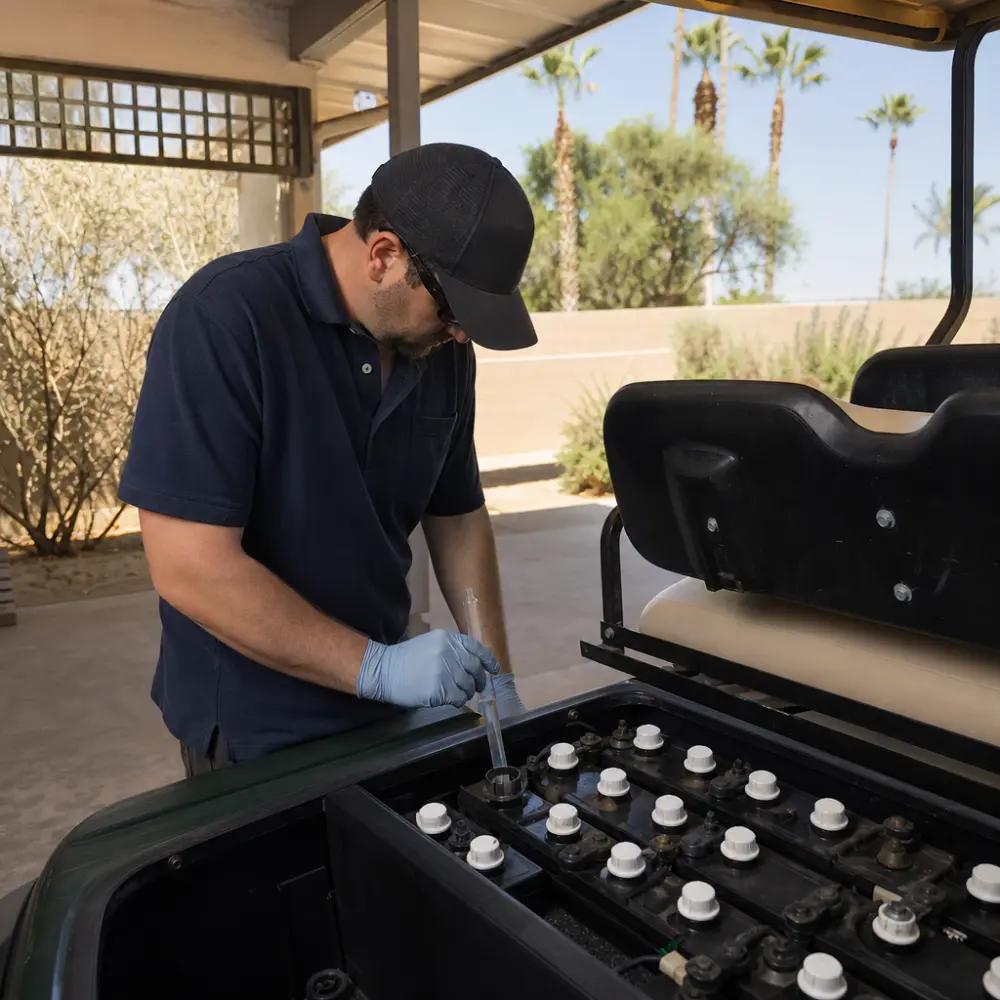
- Losing range. Per-battery load test and a hydrometer check on flooded packs, because heat this extreme sulfates plates fast and a shrinking range is often one weak battery, not a dead pack. See golf cart range dropping.
- Weak on the climb from the water. Lake Havasu City has real elevation change between the lake and the rest of town, and a cart that struggles on the way up from a dock gets a load test and a controller check before anyone assumes it just needs new tires.
- Brakes squealing or not holding, cutting out while driving, flat or dry-rotted tires, and a cart that sat all summer and will not start all get their own detailed pages under problems.
The diagnostic sequence, and why the order matters
A solenoid is cheap and easy to sell. A tired battery pack produces the exact same click-and-no-go symptom, because a pack that reads full voltage sitting still can collapse the instant a motor demands real current. That is why every visit starts with a load test on each battery individually, then pack voltage under load, then a voltage-drop check along the main cables, then the solenoid, then the controller. Testing cheapest-first means nobody pays controller money for a solenoid fault, or battery money for a corroded cable.
Why calls here skew toward heat and grade
Two things shape most repair calls in this market. First, heat: National Weather Service climate normals for Lake Havasu City put the July mean daily high at 109.3°F, and the state’s all-time hottest temperature, 128°F, was recorded here on June 29, 1994. That evaporates water out of flooded batteries fast and cooks chargers and controllers sitting in closed garages. Second, grade: the lake sits at roughly 452 feet where London Bridge crosses the Bridgewater Channel, and the city’s own airport six miles north sits at 783 feet, more than 300 feet higher. A cart working that climb daily wears brakes and drive components faster than a flat neighborhood grid would.
Gas and electric
Most carts here are electric, 36V or 48V, but gas carts get the same mobile service: starter-generators, belts, carburetors, fuel systems, spark plugs, and filters. A gas tune-up runs $150 to $300 against $100 to $200 for an electric one, covered on the tune-up service page.
What it costs
The $50 to $100 service call includes the full on-site diagnostic and is applied toward the repair when you approve the work. Beyond that, every price is published on the pricing page: solenoids $100 to $250, controllers $300 to $600, motor work $300 to $1,000, lead-acid packs $1,200 to $1,800, lithium conversions $1,600 to $3,500. The repair cost calculator turns your symptom into a range right now.
Send the brand, the model year if you know it, whether it is gas or electric, and what the cart is doing, plus a photo of the battery compartment if you can. We come to you across Lake Havasu City, Desert Hills, the Island, Parker Strip, Parker, Topock, and Golden Shores, and same-day or next-day service is routine.
Frequently Asked Questions
What does a mobile repair visit actually include?
A full on-site diagnostic first: load test on each battery, voltage checks under load, charger output test, voltage drop along the main cables, and solenoid and controller checks if the cart will not move. Then a flat quote, and the repair itself if you approve it and the parts are on the truck.
Do you carry parts on the truck or do I have to wait?
The truck carries the parts that fix most calls on the spot: battery sets, solenoids, brake shoes, drums, tires, belts, and common charger and light parts. A good description of the symptom before the visit is what lets us guess right. Uncommon parts for older or unusual carts occasionally take an extra day.
Can you come to a dock or boat garage instead of a driveway?
Yes. A lot of carts here live at a dock or in a boat garage rather than a standard driveway, and that is routine for us. Let us know the access when you book so the tech brings the right ramp or dolly.
Do you work inside HOA or gated communities?
Yes, wherever the cart is, including gated streets on the Island and along the Parker Strip. Just let the gate or guardhouse know to expect us at the scheduled window.